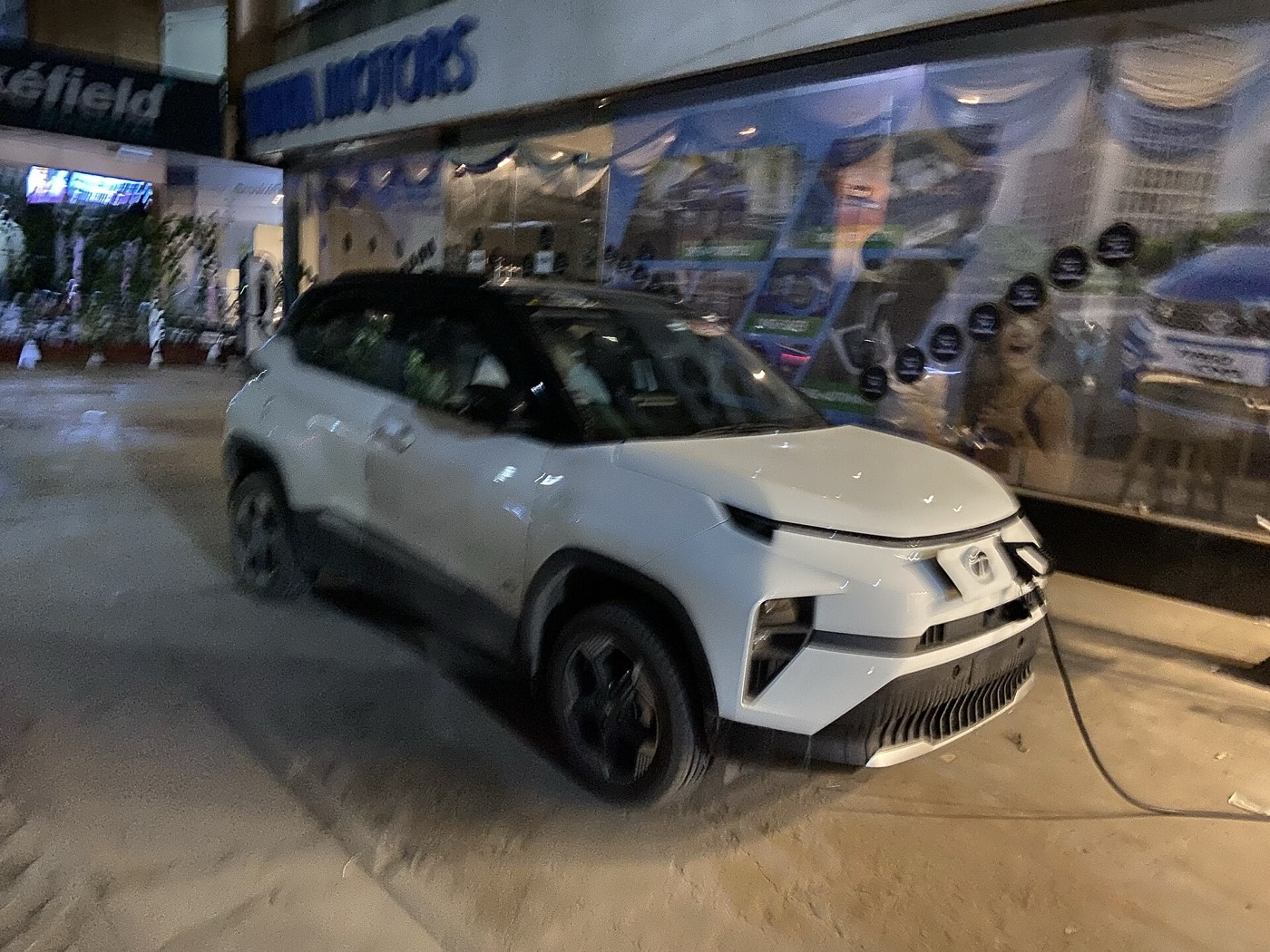
Car review
Tata Harrier review: the diesel that still makes the long-distance case
350 Nm from 1,500 rpm, a five-star shell and 4,605 mm of road-trip intent. We ran the Harrier diesel the way its buyers do — loaded, distant and on state highways — and the story is effortlessness with an urban invoice attached.
- Tata Motors Harrier ₹14.49L
MotoSutra editorial rating
4.1/5
Verdict
The Harrier is the last honest diesel road-tripper at this money, and it should be bought as exactly that: the Adventure trim at ₹16.49 lakh if you want the screens, the Accomplished AT at ₹19.69 lakh if the car will never see a clutch again. Buy it for the five-star shell, the 350 Nm and the highway; do not buy it for a parking basement. This listing gives the safety-first family more car per rupee of risk than anything else at ₹15 lakh, and that is still a thing you can buy in India only a few times.
Some cars are marketed and some cars are requisitioned. The Harrier is the second kind: you do not browse your way to it, you decide that long distances, five people and a bad-road country require it, and then you go configure one. Tata has kept the 2.0-litre diesel at the centre of the story through every update, and this review starts from the same premise the buyers do — that the torque figure is the product. We drove the Accomplished AT, a ₹19.69 lakh car in this sample listing, on the highway programme the Harrier was engineered for, and spent a week in Delhi traffic afterwards for the other side of the ledger.
Design: upright, imposing, honest
The Harrier looks like what it is. Four-six-oh-five millimetres of body, a tall greenhouse, vertical tail and 235/65 R17 wheels that fill the arches properly. It is not cute, it does not pretend to be a coupe, and the sheer wall of the side glass is what lets five adults travel without the hunched posture a sloped roofline imposes. Parked next to the compact SUVs it is priced against, the Harrier makes them look like the transition cars they are. The paint and panel gaps on our sample car were good; the switchgear feels built for the decade of service this car expects, which is Tata’s oldest and best marketing line.
Performance: 350 Nm is the whole review
The 1,999cc four makes 170 bhp at 3,500 rpm and 350 Nm from 1,500 to 3,000, and everything a Harrier buyer wants to know happens in that plateau. From 80 km/h in sixth, a firm press moves a car carrying five adults and luggage past a truck convoy with no drama, no downshift and no noise beyond a diesel bark from ahead of the bulkhead. The six-speed manual is the fun option but the torque plateau makes the conventional automatic the one to live with: it shifts without hunting, holds the right gear on a ghat climb, and never demands a paddle during an overtake.
Top speed is the claimed 180 km/h and is irrelevant; the useful Harrier number is that 120 km/h arrives so quietly in the process that the speedometer is the surprise at the end of a long straight. Overtaking on two-lane state highways stops being an event and becomes an administrative act. That transformation is what the extra money over a 1.5-litre petrol buys, and only a diesel at this size buys it this completely.
Ride: the last hour is the test
The multi-link rear and the 200 mm of clearance give the Harrier the specific highway talent that separates road-trippers from big hatchbacks: broken tarmac is absorbed rather than reported, and the car arrives at kilometre 600 with the passengers still conversational. There is body control rather than body float, and expansion joints thunk through with a solidity that reads as weight in the good sense — 1,830 kg of kerb mass, planted.
The same mass is the tax. The steering has weight but not language, and in a tight U-turn the Harrier drives like the large car it is; the rear steps out only if you are rude about it on a wet surface, at which point the stability control, standard everywhere in this listing, restores the argument.
Comfort and space: five is a real number here
The cabin is broad, the seats have long squabs, and the second row reclines enough to sleep in — which, on a night run, is a feature, not a spec. The third seat in the middle is genuinely usable, which is why the Harrier carries five without the apologetic asterisk most compact SUVs attach. The 425-litre boot takes the luggage of the five it carries. Ventilated front seats, powered driver adjustment and a panoramic option live at the top of the ladder; the base Pure S at ₹14.49 lakh buys the same shell, same engine and same six airbags, and if that sentence is your priority order, Tata has priced this car honestly.
Features: adequate, not the argument
Here the honesty has to continue. The 10.25-inch touchscreen and digital cluster on mid trims work fine, but the interface trails the Hyundai and MG equivalents in speed and polish, and the feature list at any given rupee is visibly shorter than a petrol rival’s. A 360-degree camera, powered tailgate and cruise control appear as you climb the ladder; none of them appear early. The Harrier asks you to treat equipment as the second consideration. For its buyers, it is.
Safety: the foundation
Five-star Global NCAP adult score, six airbags standard on every variant, stability control, hill hold and all-wheel discs. In a segment where the price ladder normally rations airbags, the Harrier’s structure carries the rating at the entry price, and the 4.8 safety score in this review is the catalogue’s way of saying the obvious. This is still the sentence that closes most Harrier purchase conversations in India, and it remains true.
Mileage: the number that decides the purchase
The claim is 16 kmpl. This listing’s sample owner band is 11-12 kmpl in mixed eager use and 14-15 kmpl at a restrained expressway cruise. Read that as the diesel’s covenant: if your monthly kilometres are high and highway-weighted, the range and the resale compensate; if your life is short city hops, the fuel bill, the diesel service cost and the parking difficulty all conspire against the purchase. Run your own arithmetic before the showroom does it for you.
Verdict
The Harrier remains the car you buy for a job description rather than a feature list: a five-star shell, effortless loaded overtaking and all-day comfort for the price of urban agility and a shorter equipment sheet. The Adventure at ₹16.49 lakh is the value pick; the Accomplished AT at ₹19.69 lakh is the one to live with if your commute includes a clutch you would like to stop thinking about. For a family that actually uses highways, there is still no more complete ₹15-20 lakh argument in this catalogue — and no more honest instruction manual attached to it either.
Pros and cons
What we like
- The 2.0-litre diesel pulls a fully loaded Harrier past a convoy in sixth with the air conditioning running and the throttle barely asked
- Five-star Global NCAP adult score with six airbags standard on every variant in this listing, which remains the car’s foundation argument
- Highway comfort is genuinely all-day: 200 mm of clearance, multi-link rear and seats that make kilometre 500 feel like kilometre 100
- The 425-litre boot and wide cabin carry a family of five and their luggage without renegotiating anything
What we would change
- At 4,605 mm long and 1,842 mm wide, flat-column parking is a negotiation the Harrier usually loses
- The infotainment and feature ladder trail petrol SUVs sold for the same money
- Claimed 16 kmpl falls to 11-12 in this catalogue’s sample owner reports when the torque is used the way it invites
- The diesel’s city economics are thin: if your life is 40 km of stop-start a day, a petrol or hybrid does the same job for less
Frequently asked questions
What is the Tata Harrier price in this catalogue?
This sample catalogue lists the diesel Harrier from ₹14.49 lakh to ₹20.90 lakh ex-showroom, Delhi NCR, across five variants, with the conventional automatic reserved for the top two.
What mileage does the Harrier actually give?
The claimed figure is 16 kmpl for the diesel manual. Sample owner reports in this listing land at 11-12 kmpl driven hard and 14-15 kmpl on a restrained expressway run — the diesel reward is for steady feet, not fast ones.
Is the Harrier a safe car?
It carries a five-star Global NCAP adult score in this listing, with six airbags and stability control standard on every variant. On structure-for-money, it remains the reference point of the price band.
Should I buy the Harrier diesel or a petrol SUV?
If you do more than 2,000 km a month and most of it is highway, the diesel wins on torque and range. A city-first buyer with less than 1,200 km a month is better served by a petrol SUV with a longer feature list — this car is built for distance, and the ownership math only closes on distance.